Finding a policy does not establish permission to act. Learn how to capture decision context, approval authority and unknowns, with a practical worksheet.
An AI system can find the right document and still leave an employee without enough information to make the right decision.
The policy explains the standard terms. It may say little about the exception approved for a particular customer, the conditions attached to that approval, or whether the person who authorized it still owns that decision.
For an executive evaluating AI knowledge management, that distinction matters. Finding information and establishing permission to act are different jobs.
A useful answer should help the responsible person understand what applies now. It should also make clear when the evidence is incomplete and a human decision is still required.
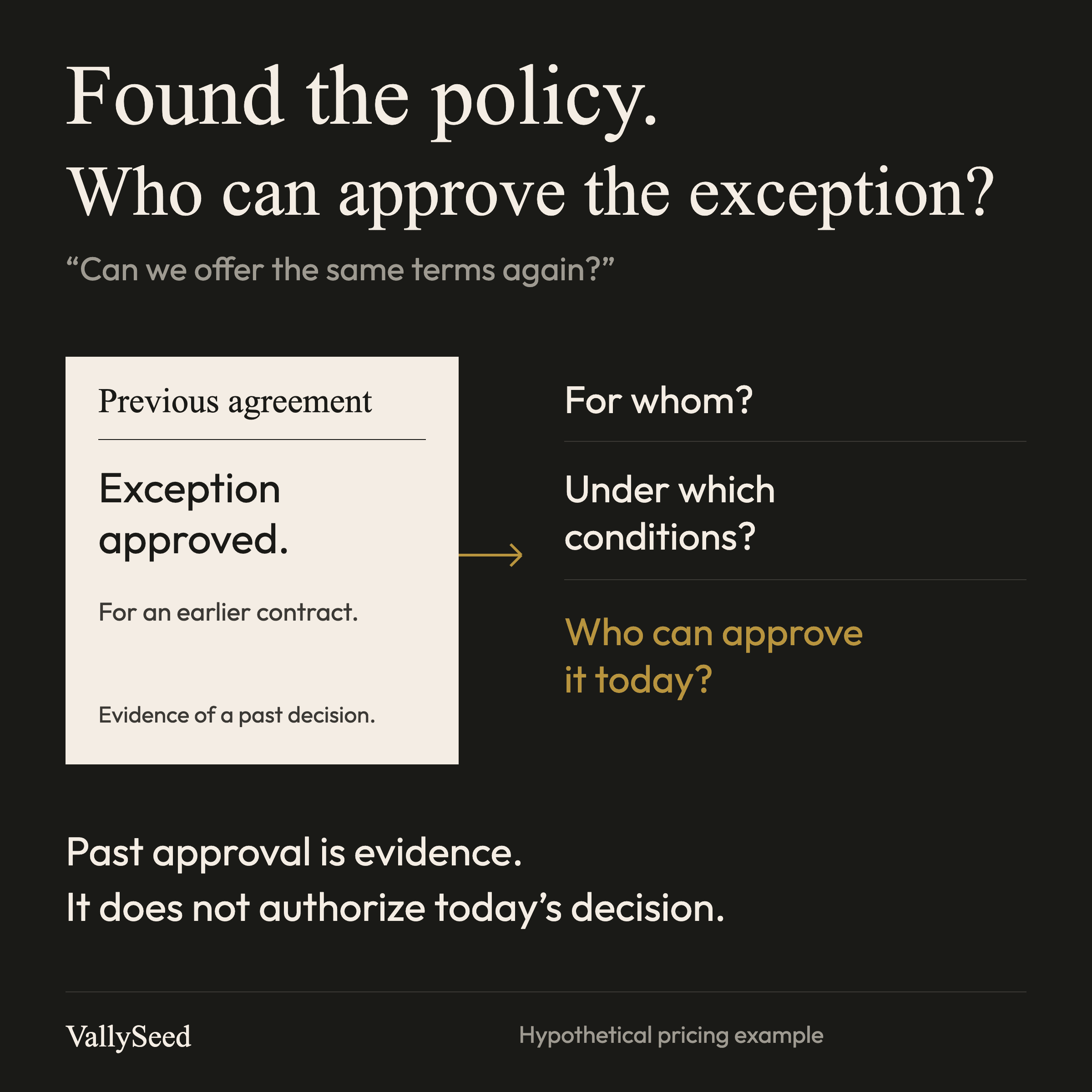
A past decision is evidence, not permission
Consider a hypothetical pricing exception. This is an illustration, not a client engagement or product demonstration.
A customer asks for terms similar to those granted on an earlier contract. An employee finds the previous agreement and asks an AI system whether the same exception is available.
The old agreement confirms that someone approved those terms. It does not necessarily establish why.
Perhaps the approval depended on a contractual commitment. Perhaps it applied to that customer alone. A later policy revision may also have changed who can authorize an exception.
A summary that says “we have approved this before” could be factually accurate while leaving out the information needed to decide today.
The employee needs to distinguish the standard policy from the earlier exception. They need to know which conditions mattered and who has authority now.
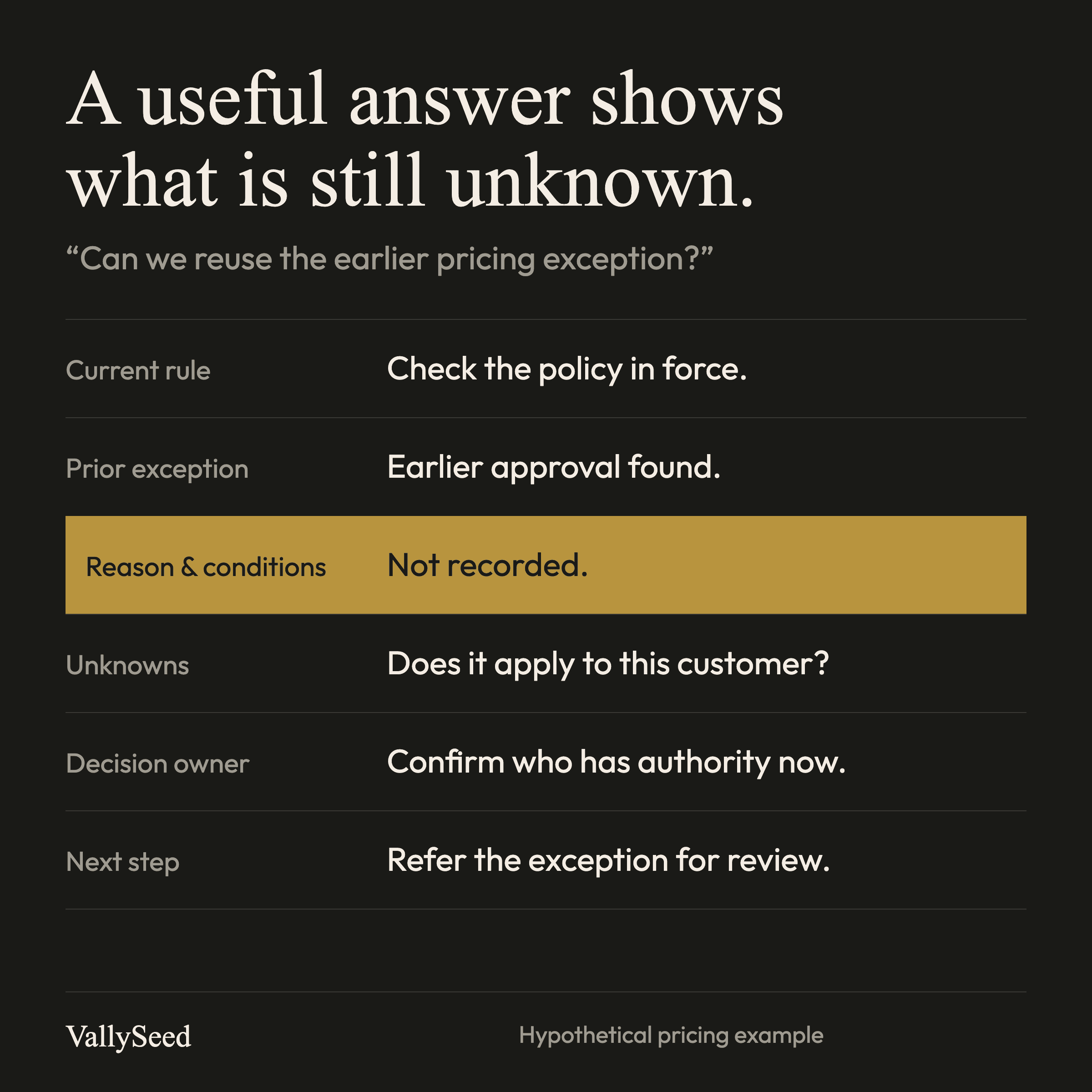
If the rationale is missing, the answer should preserve that uncertainty. A plausible explanation is not a substitute for an approved one.
Decision context belongs in the buying conversation
AI knowledge management helps people access and work with organizational knowledge. The executive question is what that assistance enables a person to do responsibly.
Can an operations manager understand why a decision was made? Can a colleague distinguish a general rule from a one-off approval? Can the person receiving an answer check whether it is still relevant?
These questions change the conversation with a provider.
A demonstration that retrieves a policy is useful. It does not settle how the organization will handle conflicting records, an undocumented exception, or a question nobody currently owns.
The NIST generative AI risk profile identifies the risk of confident but false content, including misleading explanations and citations. A polished answer therefore needs scrutiny, even when it includes references.
The reference should let someone inspect the evidence. It should not end the discussion.
Ask who can disagree with the answer
When reviewing an AI knowledge management proposal, start with the people responsible for the work.
Who owns the underlying decision?
The person maintaining a document may not be the person authorized to approve an exception. Make that distinction explicit.
What happens when sources conflict?
Employees need to recognize the disagreement and know who can resolve it. An AI-generated compromise between two incompatible policies is not an authorized policy.
What happens when the reason is unknown?
The system should not turn an incomplete history into a confident explanation. The appropriate next step may be to request more information or refer the question to a responsible person.
Which actions still require approval?
Access to a previous decision does not transfer the authority of the person who made it. Agree on the approval boundary before relying on an answer in consequential work.
Who should have access?
A useful explanation can contain sensitive commercial or personal information. Greater visibility is not automatically appropriate visibility. Include confidentiality, privacy and security requirements in the buying decision.
These are buyer questions, not claims that any particular product already meets them.
Some problems need an owner before they need AI
If two departments disagree about which policy is authoritative, an AI system should not be expected to settle the disagreement.
If nobody knows whether an exception remains valid, the first task is to establish its status.
If a decision is rare and carries significant consequences, direct human review may remain the appropriate approach.
That is a legitimate outcome. The goal is responsible decision support, not putting every question through an AI interface.
Start with a bounded decision area where the responsible people and relevant evidence are identifiable. Ask those people what they need to see before they can act.
Their answer provides a more useful starting point than a broad request to “make company knowledge searchable.”
Make the next decision easier to defend
Episode 30 of Human in the Loop asks what an AI agent needs to remember across sessions. For an organization, that question extends beyond remembering what happened.
What mattered? What remains uncertain? Who decides whether the earlier reasoning still applies?
For now, take one recurring decision to the person who owns it. Ask what evidence, exceptions and approvals a colleague would need before making the same decision again.
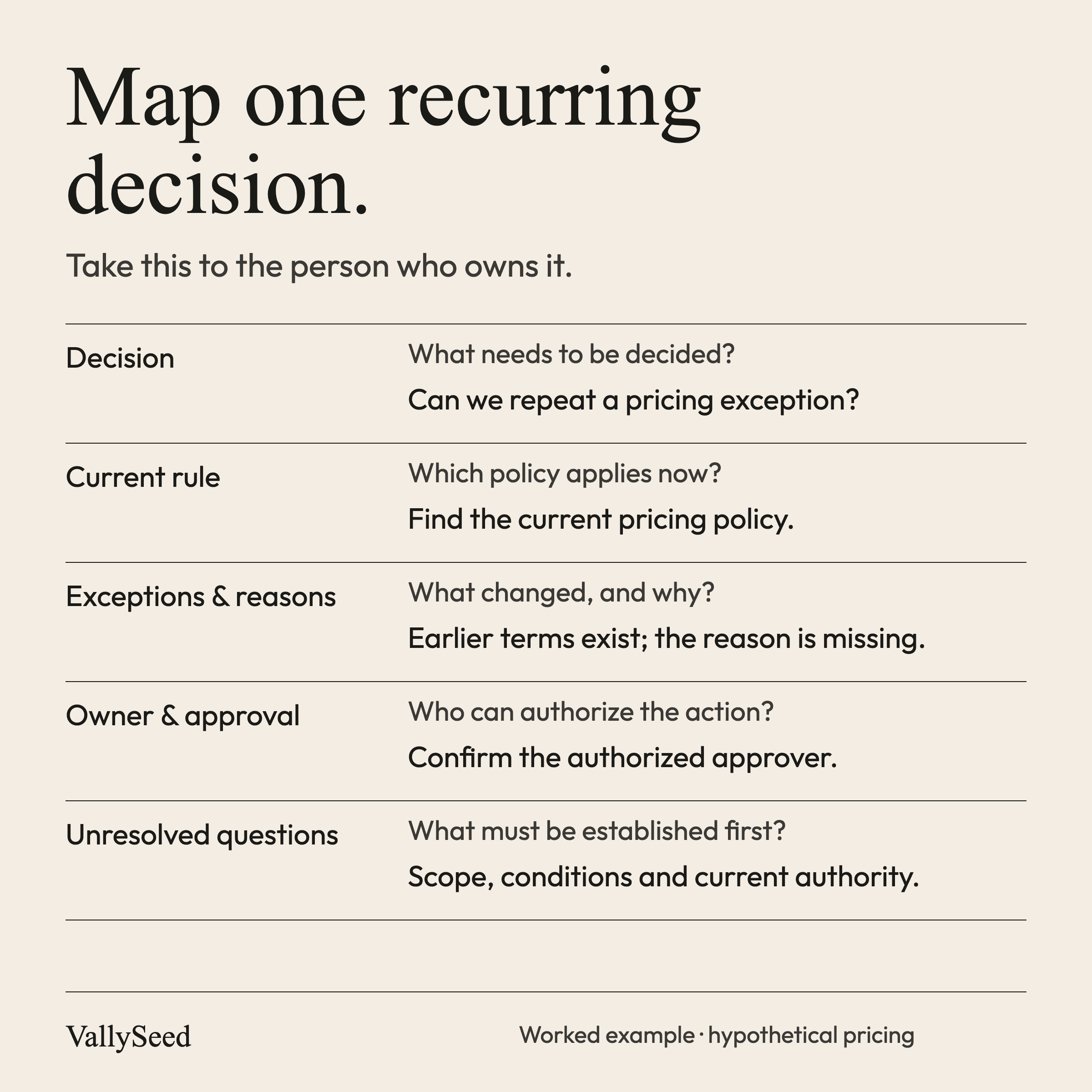
Put one decision on paper.
Get the blank worksheet and worked example by email. Fill in the PDF or print it for a conversation with the decision owner.
Which part is hardest to establish in your organization: the rule, the reason, or the authority?